Before You Buy the Office, You Check the Roof. So Why Not Your Website?
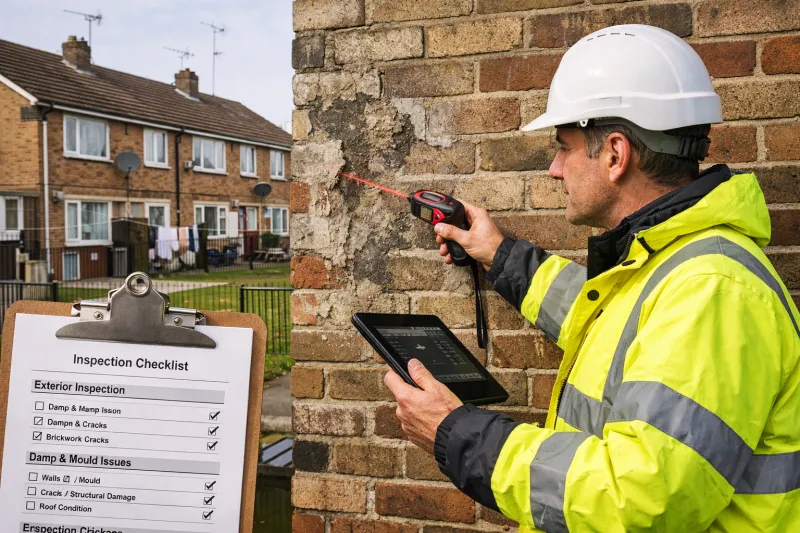
Photo: building surveyor inspecting house with clipboard UK, via zsxkvszxbhpwnvzxdydv.supabase.co
Nobody buys a house in Britain without a survey. It's practically a national ritual — a bloke in a fleece pokes around the loft, taps the walls, writes 'damp suspected' three times, and charges you £600 for the privilege. You grumble, you pay, and you're quietly glad you did when the £4,000 guttering bill arrives.
So it's a bit odd that the same British businesses would happily spend £20,000 on a website — often their single biggest commercial asset — and never once commission anything resembling an inspection.
That gap is now being filled. A small but growing band of consultants, some calling themselves digital surveyors, others preferring 'digital auditors', are doing for online presence exactly what the RICS crowd does for property: assessing condition, flagging structural risk, and delivering reports full of things the owner didn't want to hear.
The Condition Report Nobody Ordered
The pitch is simple. A chartered surveyor doesn't tell you how to redecorate; they tell you whether the building will still be standing in five years. A digital surveyor does the same for your website, your social accounts, your domain registrations, your cloud subscriptions, and the tangle of logins your former marketing person took with them to Marbella.
The findings are rarely flattering. Expired SSL certificates quietly warning off customers. A WordPress installation three major versions behind, running plugins abandoned since the last general election. A Google Business Profile still listing an office the company left in 2019. Domain names registered to a director's personal Gmail address — the one he uses for booking holidays.
None of this shows up on a homepage. All of it shows up eventually, usually at the worst possible moment.
Ten Thousand Pounds of Damp
Consider the case of a family-run manufacturing firm outside Leeds — we'll keep them anonymous, because they were mortified. They commissioned a digital condition report before a rebrand, mostly as a formality. The auditor came back with a shopping list: the site had no working backup, the e-commerce plugin had a known security flaw, and the company's entire customer database was sat in a single spreadsheet on a laptop nobody had updated since lockdown.
The fix bill came to just over £11,000. The alternative — a ransomware incident or a data breach — would have been considerably worse, and potentially reportable under GDPR. The managing director's verdict was refreshingly blunt: 'It's the cheapest nasty surprise I've ever had.'
Or take a two-partner accountancy practice in Bristol that discovered, during an audit, that its website was legally owned by the freelance developer who'd built it in 2016. Not hosted by him — owned. When he moved to Portugal and stopped answering emails, the practice had to negotiate with a man it had no contract with, for access to its own web address. The audit cost £900. The lesson was worth considerably more.
What a Proper Digital Survey Should Contain
Not all audits are created equal. The good ones, practitioners say, follow the surveyor's model: systematic, unsentimental, and written for the owner rather than the IT department. A credible digital condition report should cover:
- Ownership and access. Who legally controls the domain, the hosting, the code, the accounts? If the answer is 'a person we no longer employ', that's your first red flag.
- Structural soundness. Software versions, security patches, backups — and crucially, whether those backups have ever actually been restored. A backup nobody has tested is a hope, not a plan.
- Compliance exposure. GDPR basics, cookie consent, accessibility. Not glamorous, but the ICO doesn't care about your brand palette.
- Visibility. Search presence, listing accuracy, broken links. The stuff that quietly loses you customers without ever crashing.
- Concentration risk. One freelancer, one platform, one login holding everything together. Single points of failure are how small firms lose years of work overnight.
What it shouldn't contain is a sales pitch. The moment an 'audit' ends with 'and our agency can fix all of this for a monthly retainer', you've been shown around a house by the seller.
The British Condition
There's something distinctly British about this whole development. We are, as a nation, terrible at celebrating our digital assets and excellent at ignoring them until they smell of damp. We'll spend three hours comparing kettle prices online but sign a five-year SaaS contract on the strength of a demo. The surveyor model — sceptical, checklist-driven, faintly joyless, ultimately protective — suits us rather well.
It also reflects a wider shift in how British SMEs think about digital. For years, the website was decoration. Now it's infrastructure — the shop, the showroom, the receptionist and the filing cabinet all at once. And nobody leaves infrastructure unsurveyed.
The parallel isn't perfect, of course. Buildings degrade slowly and visibly; websites fail fast and invisibly. A surveyor can come back in five years. Your digital surveyor would probably recommend twelve months, because the online world moves quicker than brick.
But the underlying principle holds, and it's a strangely comforting one: before you invest in making something look better, find out what's holding it up. The Brits who've already had the inspection done all say the same thing. They didn't enjoy the report.
They slept better afterwards.